
Signature R&D Projects
Augmented and Holographic Mixed Reality:


Virtual Reality and 3D animated air vehicle tasks and components:

Model courtesy of: Dr. Nathan Hartman, CGT


Autonomous Vehicles and Collaborative Robots (Cobotics) for MRO and Aerospace Operations:

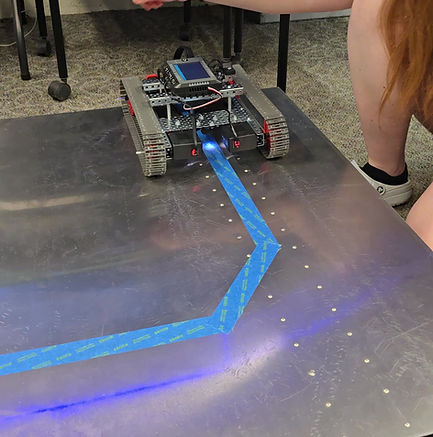
Autonomous UGV Inspection test: Sensor-guided Wing Walker following rivet and deicing boot seam lines

Our first large jet high-resolution airborne scan!
Research design: William Weldon, Ph.D

Practicing tool grasp, alignment, and docking on wing panel fasteners

Nothing happens in robotics without clean coding...UGH!


Still learning the finer points of robotic dexterity :0)
Research design team:
Lauren Smith - AET
Grace Cronin - AET
AET's first robotic maintenance assistant, "TechBuddy" first test-hop: 04 April 2023.
Wing-Bot Inspection Unit with High-Res camera and other NDT payload capabilities. On-wing test section detecting fastener and surface anomalies: August 2025.

AET Senior Student Design team:
Jarrod Ooms - AET
Jacob Seifert - AET
Paul Wegener - AET
AET Senior Student Design team:
Jacob Ramsey - AET
Alexis Madden - AET
Katelyn Evans - AET
Commercial Space
AET students wield technical and process engineering skills that NASA, Commercial Space companies, and related support industry find VERY valuable - Especially in today's rapid launch and 'return to mission-readiness' cadences using Reusable Launch Vehicles (RLV's). They're hiring our undergraduates and we needed to catch up.
One area of curiosity is exploring construction and failure modes of space vehicle structures and their shielding designs for Micro-Meteoroid and Orbital Debris (MMOD or, "space junk") at Low Earth Orbit (LEO) hypervelocity impacts. Aluminum, steel, plastics (including paint chips) are the most commonly encountered LEO debris of concern. To learn about material construction and behaviors in space, the AMT-I Center's student design teams researched and produced partial replicas of a legacy design used by NASA (Whipple Shielding).
In Phase I, we replicated a metal-layered Whipple shield, testing supersonic projectile impacts in Earth atmosphere at about 600 feet MSL, close to Standard Day. Of course the projectiles went completely through all four layers (first picture below with the four holes).
Phase II was built for an actual hypersonic shot replicating Low Earth Orbit collision. The design altered spacing between plates, to evaluate plasma debris spread and containment for a projectile moving at MACH 20 (well, technically it was in a vacuum like space, without air medium, so MACH isn't really a space measure. But it helps put it into perspective. It was hauling!). We used University of Dayton Impact Physics Laboratory's hypersonic air gun in a vacuum chamber, firing an aluminum sphere targeting 7 km/sec. It turned to plasma on impact with the lead bumper shield. The debris cone was contained on the second plate (the second picture below). This test was a FIRST for SATT and AET in the Space arena! We also did some additional science, too long to post here, and got COOL radiograph pics of the plasma debris cloud. Don't worry, we had our safety glasses on.
Phase III: we're currently experimenting with smaller, lighter, semi-flexible shield designs incorporating composite layering like Nextel, Kevlar and other magic Star Wars materials where we can identify them. Orbital kinematics is cool - and VERY challenging! But, "One small step", right?
Orbital Vehicle Space Debris Shield
Phase I: Supersonic (Earth Atmosphere) projectile test


Phase II: